
Uncategorized
The Hanacaraka Script: The History of Javanese Letter in The River of Time
Mar
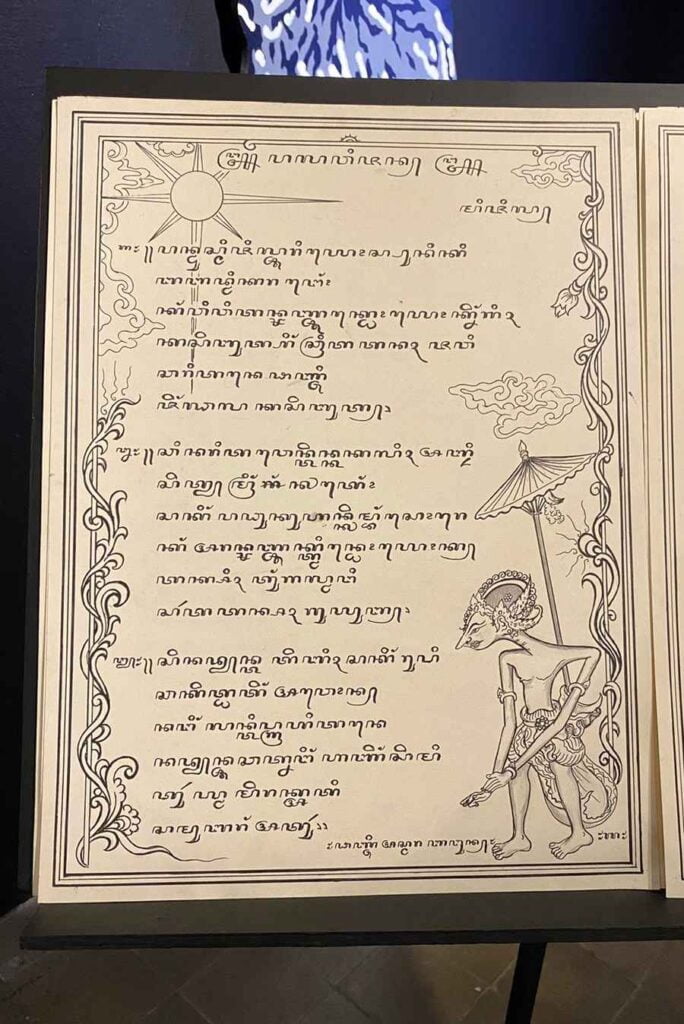
According to the legend, the Javanese letter or called Hanacaraka was born from the story of a handsome supernatural fighter named Aji Saka. One day, he went on a journey to the Medhangkamulan Kingdom in the island of Java. The kingdom had a king named Dewata Jengkar, who is a cannibal and very greedy. The king has a daily ritual of eating a human. Therefore, many people are afraid of the king. In order to stop his cruel behaviors, Aji Saka decided to leave the island to kill the king.
Aji Saka is always accompanied by two of his disciples, Dora and Sembada. When Ajisaka wandered to the Medhangkamulan Kingdom, he invited Dora to accompany him. On the other hand, Sembada was instructed to guard his Keris (a Javanese dagger) and remain on the Indian island of Majethi in order to prevent the Keris from slipping into the wrongdoer’s hands. One day, after he defeated Dewata Jengkar with his supernatural powers, Aji Saka remembered that he needed to take back his Keris. Aji Saka instructed Dora to go to Majethi Island to see Sembada and ask for his weapon. When he arrived, Sembada refused to give the Keris to Dora. So, the two disciples of Aji Saka fought fiercely. They were both equally powerful, and neither of them gave in. In the end, both of them unfortunately died. After a long wait without any news from Dora, Aji Saka decided to head to Majethi Island and see what had happened. He was very surprised when he found out that both of his loyal disciples had died. They both died because of their loyalty to him and he regretted having given the command. To remember his past actions, he created meaningful words, which sounds like:
Ha Na Ca Ra Ka
Da Ta Sa Wa La
Pa Dha Ja Ya Nya
Ma Ga Ba Tha Nga
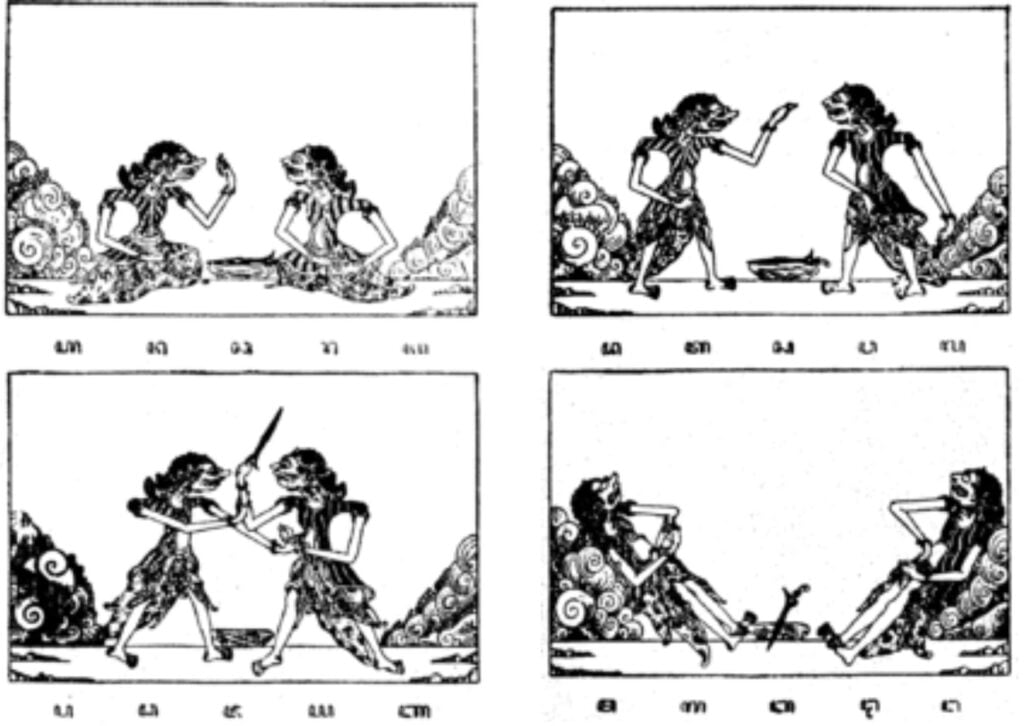
Means:
Ha-Na-Ca-Ra-Ka means “messenger”, that is, human messengers from God in the form of breath (soul) and body have the obligation to carry out assignments from God to protect nature on earth. This shows the existence of a creator (God), creation (human), and the task given by God to humans.
Da-Ta-Sa-Wa-La. Humans should follow God’s rules after being created up or “data”. Then they can not be “sawala” or evasive. In this life humans must be willing to carry out, accept and do the God’s will who created us.
Pa-Dha-Ja-Ya-Nya shows the union of the life-giving substance (divine) and the one who is given life (creature). The philosophical meaning is that every human mind must be in accordance with what it does.
Ma-Ga-Ba-Tha-Nga means accepting everything commanded and forbidden by God. This means that humans must surrender, sumarah to the natural line, even though humans are given the right to mewiradat, try to overcome it.
The Hanacaraka Javanese script was not very popular during the kingdoms of Kediri, Singasari and Majapahit (Kingdom in the island of Java around 12th to 16th century). Afterwards, the story of the Hanacaraka script was raised again during the reign of the New Mataram Kingdom. It appears in a literary work entitled “Serat Sastra Gending” which is the work of one of the famous Mataram Javanese kings. He is Sultan Agung Prabu Anyakrakusuma (1593-1645), known as Sultan Agung, who ruled the island of Java from 1613 to 1645.
One of the quotes from “Serat Sastra Gending” is as follows:
“Kadya sastra kalidasa, wit pangestu tuduh kareping puji, puji asaling tumuwuh, mirit sang akadiyat, ponang : Ha na ca ra ka : pituduhipun, dene kang : da ta sa wa la; kagetyan ingkang pinuji ” which can be interpreted as “Like literature (the Javanese script) twenty (is) as a beginner to reach the truth, which places instructions on the meaning of praise, and praise to all sources that grow (or live); giving (mirit) akadiyat teachings in the form of ha na ca ra ka, the instructions”. While da ta sa wa la, means to (to God) who is praised “.
A few quotes from the work “Serat Sastra Gending” implies a role in society. The Hanacaraka script is re-used by Javanese writers. Because of a direct order from Sultan Agung as the king of the Mataram Javanese kingdom, all Javanese writers at that time used the Hanacaraka script as a standard for making their works. So, all literary works written by Javanese writers use the Hanacaraka script.

Sultan Agung also changed the Javanese calendar system by adopting the Hijri calendar. Even if the calendars are mixed, the Saka year numbers are continued, from 1547 Saka the Javanese calendar still continues the year numbers from 1547 Saka to 1547 Java. Sultan Agung’s intention at that time was to strengthen the new Mataram kingdom by getting rid of foreign cultures through the Javanese Hanacaraka script and the Javanese calendar.
In today’s Javanese society, the influence of the Hanacaraka script can be seen in the education field. An example is the teaching of Javanese in elementary schools (Sekolah Dasar) in Central Java and Yogyakarta Region. This Javanese language teaching provided a mixture of modern Javanese with the Hanacaraka script and Javanese grammar (Kromo/formal language). The purpose of teaching and learning the Hanacaraka script in modern Javanese is to remain sustainable and survive with the times.
Glossary
Hijri calendar: It is Muslim calendar consisting of 12 lunar months in a year of 354 or 355 days and is used to determine the proper days of Islamic holidays and rituals, such as the annual fasting and the annual season for the great pilgrimage.
