
Uncategorized
The Myth of the Twin in Nias – Silogu and Siraso
Mar
Indonesia has many variations to portray the goddess of fertility. As an archipelago, every ethnic group in Indonesia has developed its own belief system, giving their gods and goddesses a variety of titles and creating its own mythology. Because Indonesians live in an agrarian culture, the goddess of fertility is commonly referred to as the goddess of rice, as rice is their staple food. As a result, rice has become a symbol of fecundity.
From many stories, Dewi Sri becomes the most popular figure of fertility goddess. The story of Dewi Sri originally came from Java but it spread widely and is worshiped by several largest ethnic groups in Indonesia such as Balinese, Sundanese, Sasaknese, and Bugis. However, there is another intriguing tale from Nias, an island in North Sumatra, that tells not only about its goddess and her superpower, but also about the myth of fraternal twins in Nias society. This is the tale of Buruti Siarso and her twin brother.
Once upon a time, there lived a king named Bulugu Silaride Ana’a. Based on their astrological myth, the Nias people believe that the sky consists of nine layers. The Nias society believes that King Bugu Silaride Ana’a is the king of the Teteholi Kingdom who comes from the celestial world in the sky.
Many years since the King reigned, he has never been blessed with a successor to the throne. As time passed by, the Empress finally became pregnant. The King and the Empress were blessed with a twin, a boy and a girl. The boy is named Silogu Mbana, while the girl is named Buruti Siarso. They both have supernatural powers that pass through their father. As they grew older their magical abilities became stronger and clearer. When Silogu Mbana goes during the harvesting season, the corps will grow significantly because he has the ability to multiply crops. The farmers are always looking forward to him coming to the harvest ceremony. However, during planting season, the farmers rely more on Buruti Siraso’s magical ability to plant the seeds because any seeds held by her will produce abundantly. The strength of the two complement each other in the harvest and planting period.
The King loved his twins dearly because he had long wanted to have children far before he got the two. Unfortunately, according to the Nias society, twins with different genders are a disgrace to the family. According to local belief, twins of different genders had been set up as a pair by Sihai God since they were in the womb, so they were considered illegitimate.
The King did not care if his two children were considered a family disgrace. However, he was worried that his twin children would end up being together just as the local legend predicted. He couldn’t bear seeing his two children grow closer day by day. By concern, the King sent Silogu Mbana to immediately find a wife. Then, Silogu Mbana complied with his father’s request and left his twin sister. Because he already feels close and comfortable with his sister, he asked his future wife to be like her. Silogu Mbana’s journey to find his future wife made Buruti Siarso felt sad. Seeing his daughter’s sadness, The King Bugu Silaride Ana’a was increasingly convinced that his daughter was in love with her twin brother. Then the King prepared the next scenario to separate his children. He asked Princess Buruti Siraso to come down to Tano Niha and help local farmers with her magical ability.
Before Buruti Siarso arrived, farmers in Tano Niha had difficulty growing crops. This made Buruti Siarso’s arrival highly anticipated. Buruti Siraso agreed to his father’s request and went down to the mainland to share the seeds she brought to the farmers. Her seed brings blessings to local farmers because it produces bountiful crops. The locals also called her The Princess of Seed (Putri Bibit).
On the other hand, Silogu Mbana failed to find a life partner. Unfortunately, when he arrived and wanted to let go of his longing for his twin sister, he was confronted with the obituary. His parents informed him that his twin sister, Buruti Siarso, had died. They took Silogu Mbana to his sister’s grave. Silogu broke down as he approached the cemetery. He had no idea that Buruti Siarso’s death was actually part of his parents’ plan to separate their children who had formed a romantic relationship.
Far away, Buruti Siraso lives near the mouth of the Oyo River. Buruti Siarso likes to help the local residents so that they get abundant agricultural and animal husbandry products. She stayed and never returned to see her family. Buruti Siraso’s fake death separates the two siblings for good. Silogu Mbana believed that his twin sister had died and his parents had kept his twin sister’s existence a secret. He did not know that Buruti Siarso lived at the mouth of the Oya River, Tano Niha.
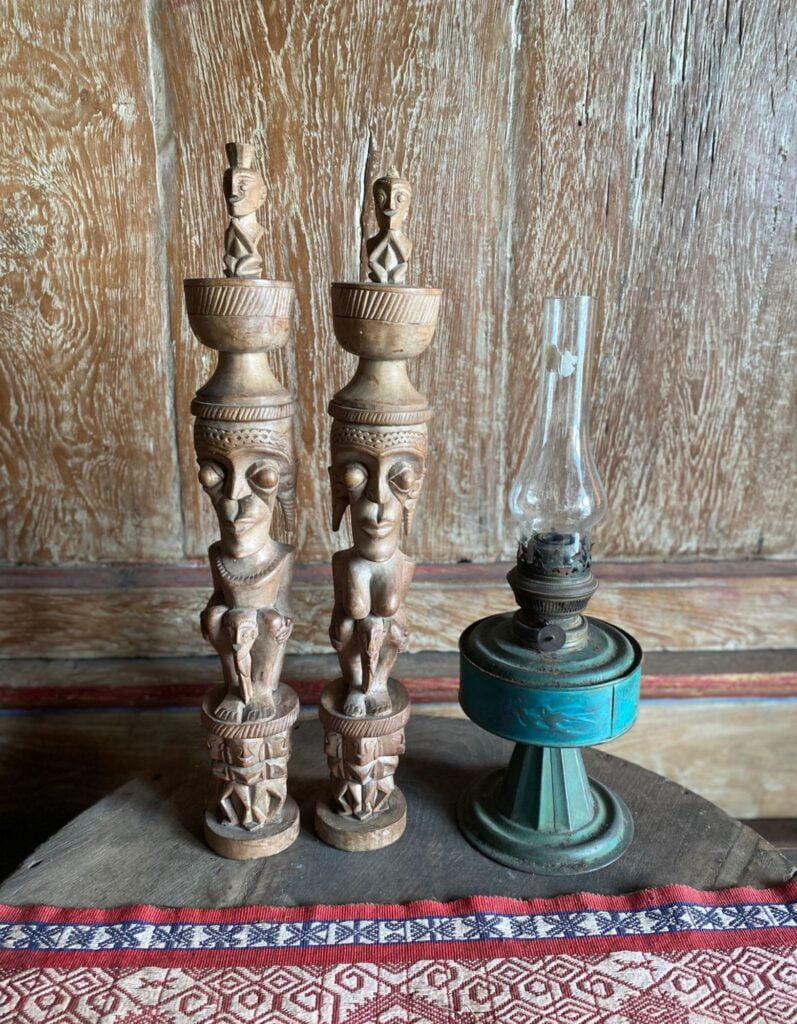
The people of Nias made statues of Buruti Siraso as the Goddess of Seeds and Silogu Mbana as the God of Harvests. In the past, farmers in Nias would ask Buruti Siarso and Silogu Mbana for blessings so that agricultural produce would be abundant and pest-free. Since the arrival of foreign religions, belief in the gods and goddesses of Nias has been abandoned. The power of Buruti Siarso and Silogu Mbana in Nias is starting to be forgotten. The story of the two is only considered a myth and is no longer exceptional for the people of Nias.
