
Uncategorized
Ondel-ondel: A Reflection of Betawi’s Cultural Acculturation
Mar
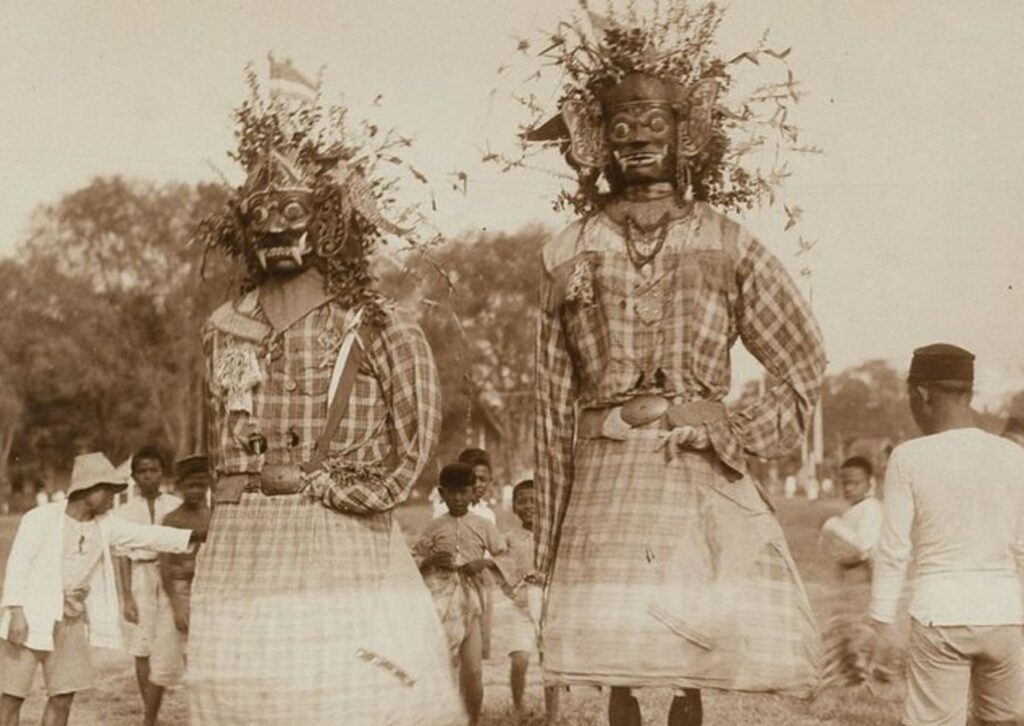
Betawi is the native ethnic group of Jakarta and is often considered a melting pot of various local and foreign cultures. The Sunda Kelapa port once served as an important international trade route, attracting many foreign traders. After the conquest of Jayakarta, the Dutch brought people from various ethnic groups to rebuild Batavia. As a result, Betawi culture emerged as an acculturation of Sundanese, Javanese, Balinese, Bugis, Malay, Chinese, Arab, and European influences. One of the most well-known Betawi cultures is Ondel-ondel. It is a traditional performance art originating from Betawi Pinggir, shaped by strong Sundanese and Chinese influences, and now recognized as an icon of Jakarta and the Betawi community.
The exact origins of Ondel-ondel remain uncertain, but several historical records mention its early existence. Fruin Mees, in Geschiedenis van Java, described a convoy escorting the Prince of Jayakarta to attend the circumcision ceremony of the King of Banten, Wijaya Abdul Mafakhir, in the 17th century. The procession consisted of 300 guards and 300 maids carrying gifts, along with a pair of giant puppets that were believed to be the predecessors of what we now know as Ondel-ondel. Additionally, the English trader W. Scot noted that in 1605, similar giant puppets were found in villages and official buildings in Batavia.
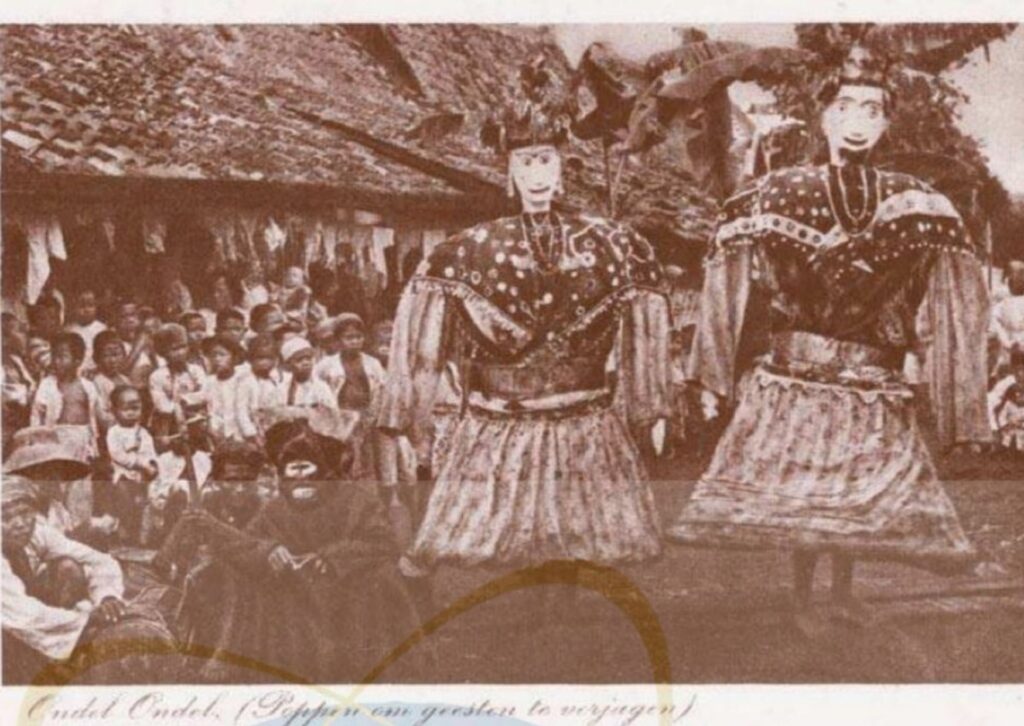
Originally, Ondel-ondel was known as Barongan, which means a group or entourage in the Betawi language, reflecting the fact that the performance could not be conducted individually. The term Ondel-ondel became popular after Betawi comedian and actor Benyamin Sueb popularized the song “Ondel-ondel.” However, the term had already been used by communities in Betawi Tengah before the song gained popularity, while Betawi Pinggir communities continued to use the term Barongan. The meaning of Ondel-ondel itself remains unclear, though some suggest it derives from gondel-gondel, meaning “to hang,” referring to the swaying movement of its arms while walking.
The roots of Ondel-ondel are still debated. Some argue that it originates from Balinese Hindu culture, particularly following the destruction of Batavia during wars against the VOC, when Governor-General Jan Pieterszoon Coen brought Balinese people to rebuild the city. Others suggest Chinese cultural influence due to its resemblance to Barongsai (lion dance). It also shares similarities with Barong Landung, which itself represents an acculturation of Balinese and Chinese traditions.
Ondel-ondel was created by the Betawi Pinggir community, who believed that large figures embodied immense spiritual power. In the past, these figures had frightening faces, long hair, and were larger than today’s versions. They symbolized ancestral spirits believed to protect the village and were also used as mediators between humans and the spiritual realm.
Initially, Ondel-ondel was considered a sacred performance, presented during traditional or life-cycle ceremonies such as weddings and circumcisions. It embodied animistic beliefs and was thought to be inhabited by spirits. Before performances, a ritual called ukup (fumigation) was conducted, in which the figures were exposed to incense. Offerings were also prepared to open pathways to the surrounding spiritual realm.
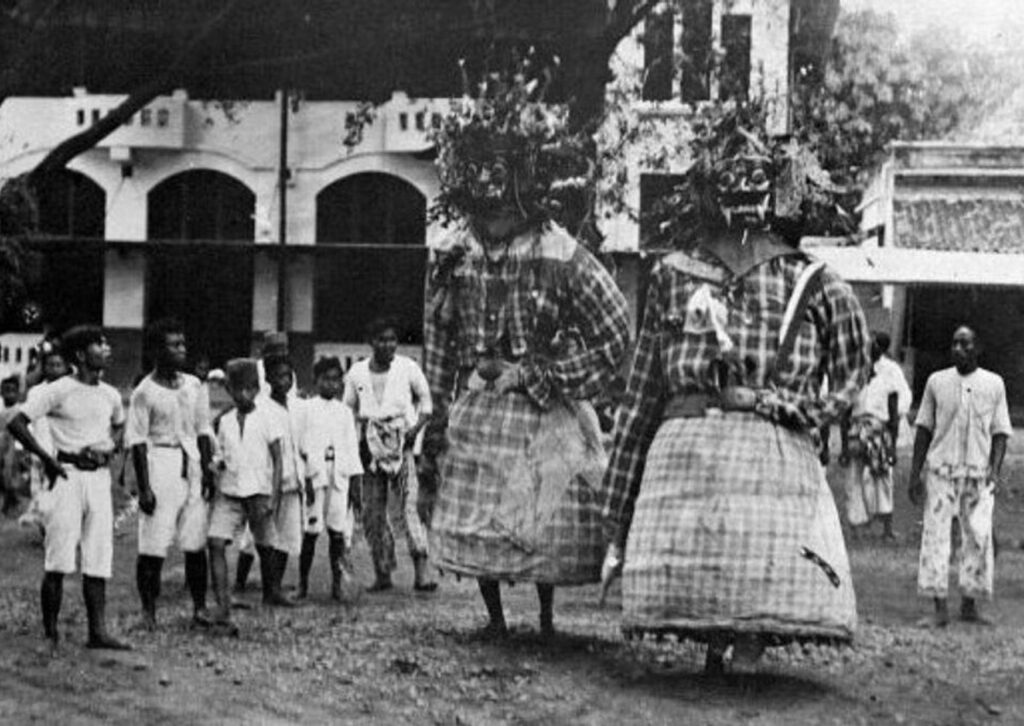
At first, Ondel-ondel was not widely accepted by the Betawi Tengah community, which was more strongly influenced by Islamic traditions from Malay and Arab cultures. Its animistic elements were seen as contradictory to Islamic beliefs, although some Betawi Muslim communities accepted it. Many of the ritualistic elements, such as offerings and spiritual practices, were gradually removed. Over the time, Ondel-ondel transitioned into a cultural symbol rather than a spiritual protector.
Typically, Ondel-ondel stands approximately 2–3 meters tall with a diameter of around 80 cm. Its structure is made from bamboo or rattan, while the mask is crafted from wood such as cempaka, cananga, rambutan, or kapok. Its oversized form symbolizes a force greater than human power. The head is adorned with coconut flower decorations, reflecting Jakarta’s historical identity as a coastal city abundant with coconut trees.
Traditionally, Ondel-ondel is performed in pairs: male and female. The male figure has a red face symbolizing courage and strength, often enhanced with fangs and a beard, while the female figure has a white face representing purity and kindness. In Indonesian puppetry traditions, colors carry symbolic meanings and are often associated with character traits and cardinal directions.
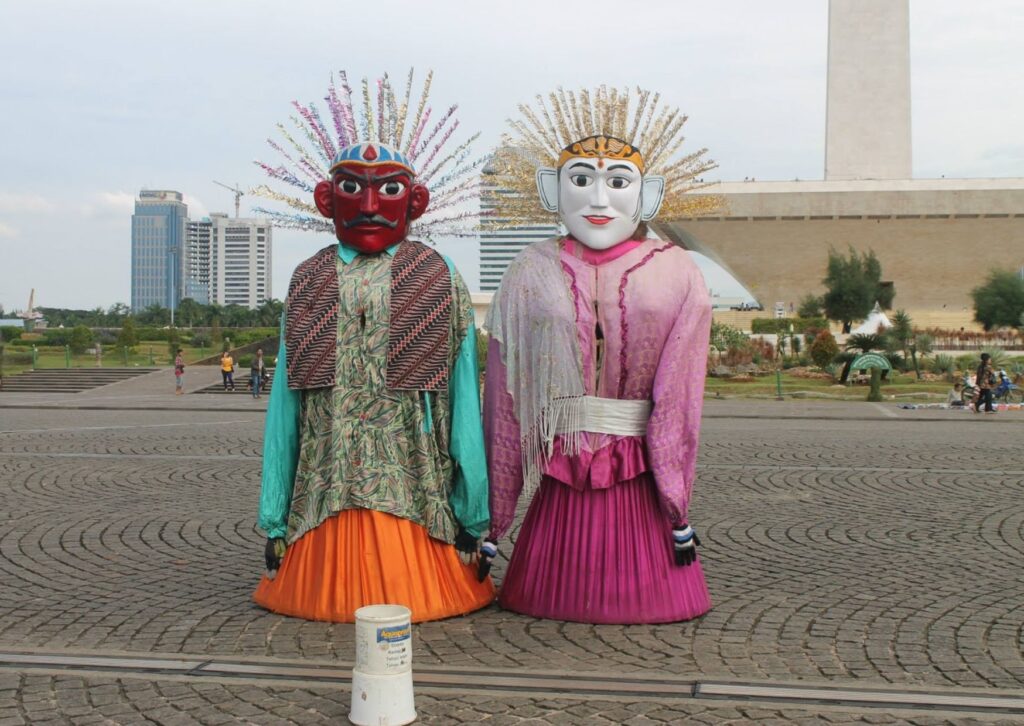
The female Ondel-ondel wears kebaya encim, reflecting Chinese cultural influence, while the male figure wears sadaria or ikat serong, traditional Betawi attire influenced by Arab culture. Female figures are adorned with floral motifs, whereas male figures often feature checkered patterns or cukin (sarong shawls). For lower garments, females wear Betawi batik sarongs with floral patterns, while males wear jamblang sarongs. Common costume colors include red, pink, orange, yellow, green, blue, black, and white.
In 1970, Jakarta Governor Ali Sadikin officially designated Ondel-ondel as an icon of the city. This recognition required significant transformation, involving negotiations between Betawi elites, such as government officials and religious leaders, and Betawi artists. The Jakarta government also played a role in revitalizing Ondel-ondel as part of its tourism development strategy.
As Ondel-ondel gained popularity as a metropolitan icon, further transformations occurred. Costume designs shifted from contrasting to more harmonious color schemes, often tailored to specific events and audience preferences. Due to the scarcity of traditional materials in modern Jakarta, fiberglass has increasingly replaced natural materials as a more practical and economical alternative.
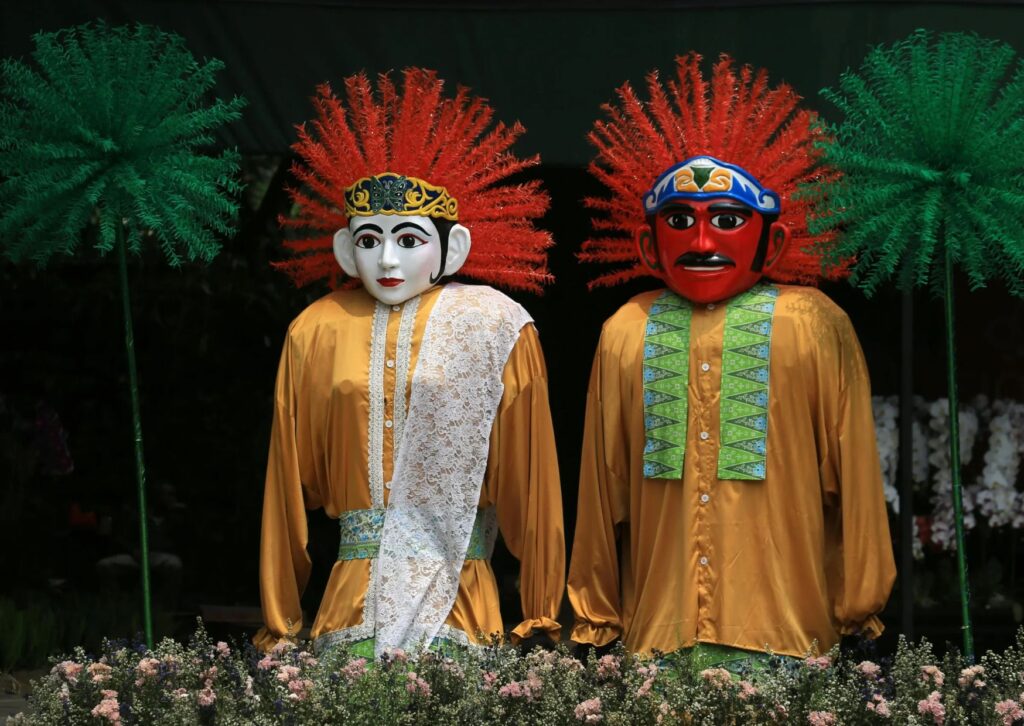
The appearance of Ondel-ondel has also evolved. Previously designed to ward off misfortune with frightening features, it is now made to appear more friendly and approachable. This transformation reflects the openness of Betawi society toward diversity. Performances have also become more flexible. Ondel-ondel is no longer needs to appear in pairs and can perform individually. Traditional musical accompaniment, such as pencu bonang, kempul, and kendang, is sometimes replaced by recorded music, which tends to be more lively.
Today, Ondel-ondel is no longer limited to traditional ceremonies and can be performed on demand. It may be combined with other art forms such as Pencak Silat or Gambang Kromong, and even appear alongside modern bands. Trance elements are no longer part of the performance. In contemporary Jakarta, Ondel-ondel continues to survive and evolve as both a cultural symbol and a tourism attraction. It is not only performed but also sold in the form of crafts and souvenirs. However, its use in street performances for busking has sparked controversy. Many argue that using a symbol deeply rooted in ancestral heritage for commercial street entertainment diminishes its cultural value, especially when performances no longer adhere to traditional customs. Its sacred meaning has, in many ways, shifted into a more casual and commercialized form of entertainment.
Bibliography
Callula, S., Nolani, P., & Ramadhan, M. (2022). Strategi mempertahankan budaya Ondel-ondel dalam revitalisasi kebudayaan Betawi. Arif: Jurnal sastra dan Kearifan Lokal, 1(2), 304-317. https://doi.org/10.21009/Arif.012.08
Handayani, Y., Rakhman, A., & Hidayat, A. (2023). Ondel-ondel sebagai ikon seni tradisi Betawi. Chronologia, 5(1), 35-44. http://dx.doi.org/10.22236/jhe.v5i1.11563
Lissandhi, A. (n.d). The artistry of Ondel-ondel. Jakarta: LIPI.
Nasiri, M. (2016, June 22). Mengenal makna simbolik Ondel-ondel. CNN Indonesia. https://www.cnnindonesia.com/hiburan/20160622182515-241-140178/mengenal-makna-simbolik-ondel-ondel
Purbasari, M., Marianto, M., & Burhan, M. (2019). Ondel-ondel kekinian: Boneka besar Betawi di zaman modern. Productum: Jurnal Desain Produk (Pengetahuan dan Perancangan Produk), 3(6), 183-188. https://doi.org/10.24821/productum.v3i6.2429
Suriyadarma, S. (2018). Mengenal Kebudayaan Ondel-ondel Betawi di Taman Mini Indonesia Indah Jakarta. Domestic Case Study 2018. Yogyakarta: Sekolah Tinggi Pariwasata Ambarrukmo Yogyakarta.
Wahidiyat, M. & Carollina, D. (2023). Study of iconography and iconology on the visual appearance of Ondel-ondel. Cogent Arts & Humanities, 10(1), 1-10. https://doi.org/10.1080/23311983.2023.2257938
