
Uncategorized
Tracing the Roots of the Sundanese Indigenous Belief
Feb
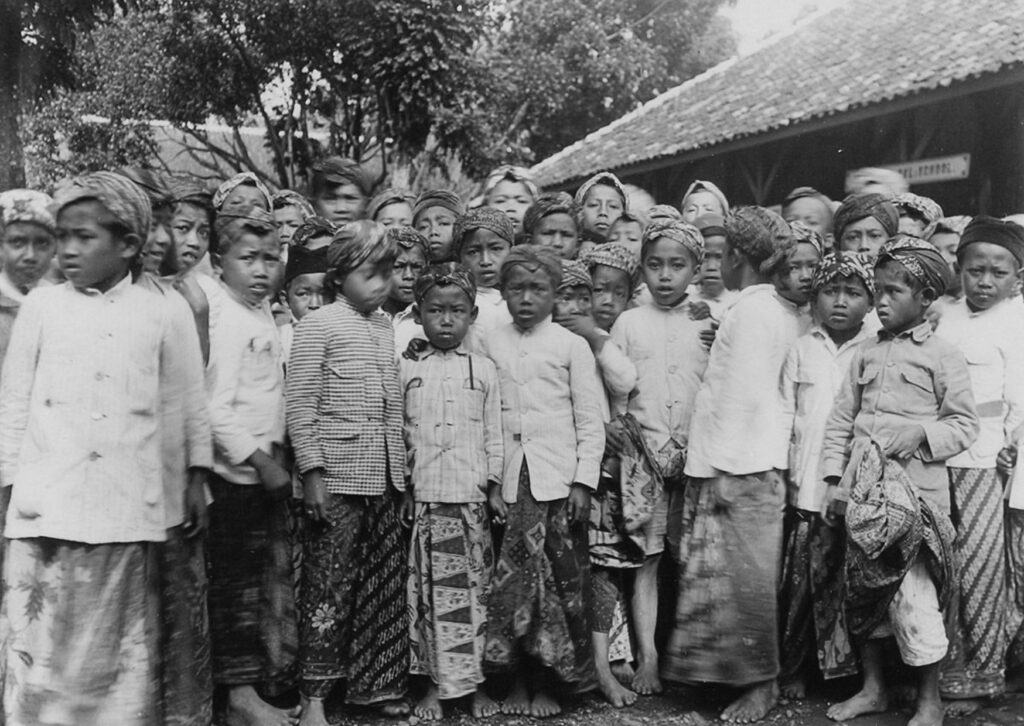
Sunda Wiwitan, commonly regarded as one of the oldest indigenous belief traditions of the Sundanese people, occupies a distinctive and at times complex position within Indonesia’s religious landscape. Grounded in ancestral cosmology, it represents not merely a form of worship, but a broader cultural framework encompassing ethical principles, social values, and ways of relating to both the natural world and the spiritual realm. Despite its deep historical roots, Sunda Wiwitan has long existed at the margins of dominant religious traditions and formal state recognition, situated between cultural heritage and institutional religion.
The term wiwitan derives from the Sundanese language and conveys the meaning of “beginning”. There are no definitive written records that specify when or where this belief system first emerged. Nevertheless, it is widely held within the community that Sunda Wiwitan has existed since the earliest formation of Sundanese civilization, long before the arrival of external cultural and religious influences in the Indonesian archipelago.
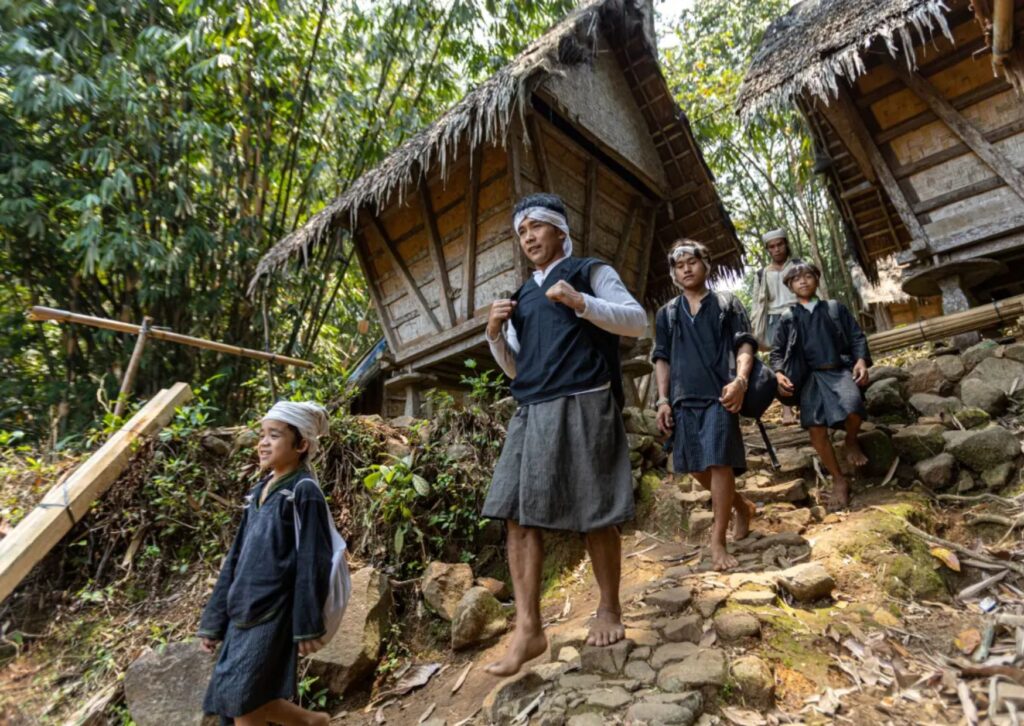
Beyond its historical origins, Sunda Wiwitan continues to thrive as a living tradition within several customary communities across West Java and Banten. Its principal centre is Desa Kanekes, home to the Baduy community, particularly the Baduy Dalam, who are widely regarded as the most consistent custodians of ancestral teachings owing to their strict observance of customary law and relative insulation from external religious influence. The tradition is also practised in Cigugur, especially within the Paseban Tri Panca Tunggal community, and in Kampung Adat Cireundeu, as well as in parts of Bogor, Sukabumi, and Tasikmalaya. Outside the secluded Baduy Dalam community, Sunda Wiwitan has generally interacted with Islam, producing syncretic forms in which Islamic practices coexist with indigenous cosmology rather than replacing it.
The Origins of Sunda Wiwitan
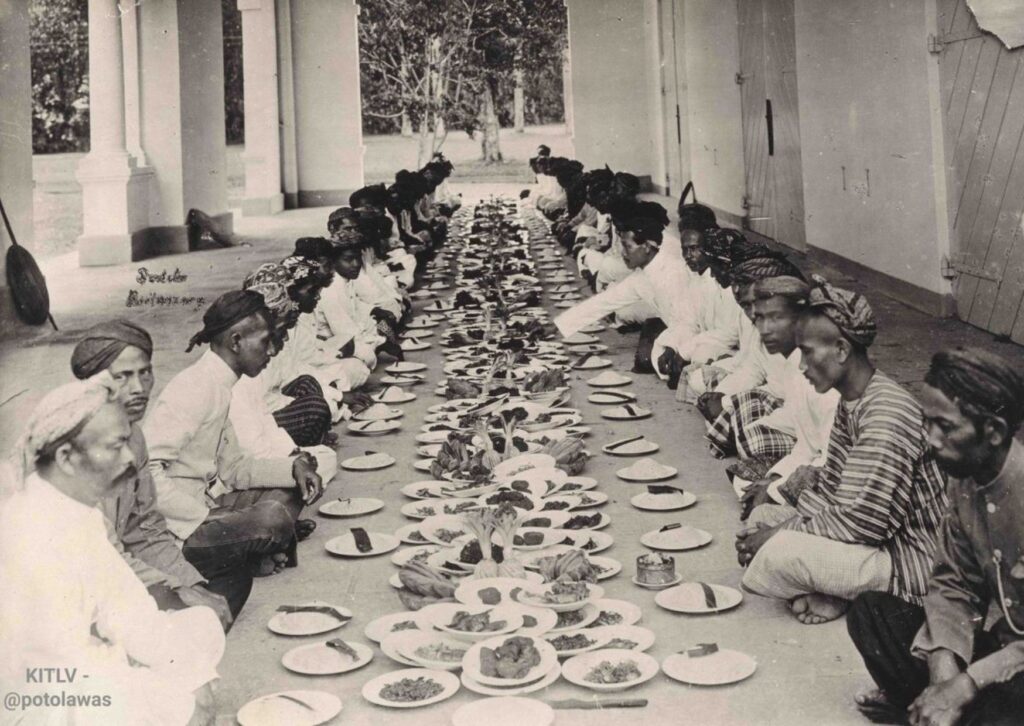
Some historical accounts and anthropological studies suggest that the Sundanese had developed a sophisticated spiritual framework well before the rise of the Hindu–Buddhist kingdoms. Archaeological findings like menhirs, dolmens, terraced sanctuaries (punden berundak), and other sacred sites across West Java and Banten, provide material evidence of established spiritual practices dating back thousands of years. These remains lend support to the view that the foundations of Sunda Wiwitan were already in place prior to the introduction of Hindu–Buddhist traditions in Tatar Pasundan (the Sunda homeland).
Within this early cosmology, the universe was understood as profoundly interconnected. Mountains were regarded as the dwelling places of deities and ancestral spirits, water as a sacred source of life, and the earth as a nurturing mother. Such perspectives reflect the core orientation of Sunda Wiwitan, which places strong emphasis on maintaining harmony between human beings and the natural world.
Pikukuh Telu: Foundational Principles of Life in Sunda Wiwitan
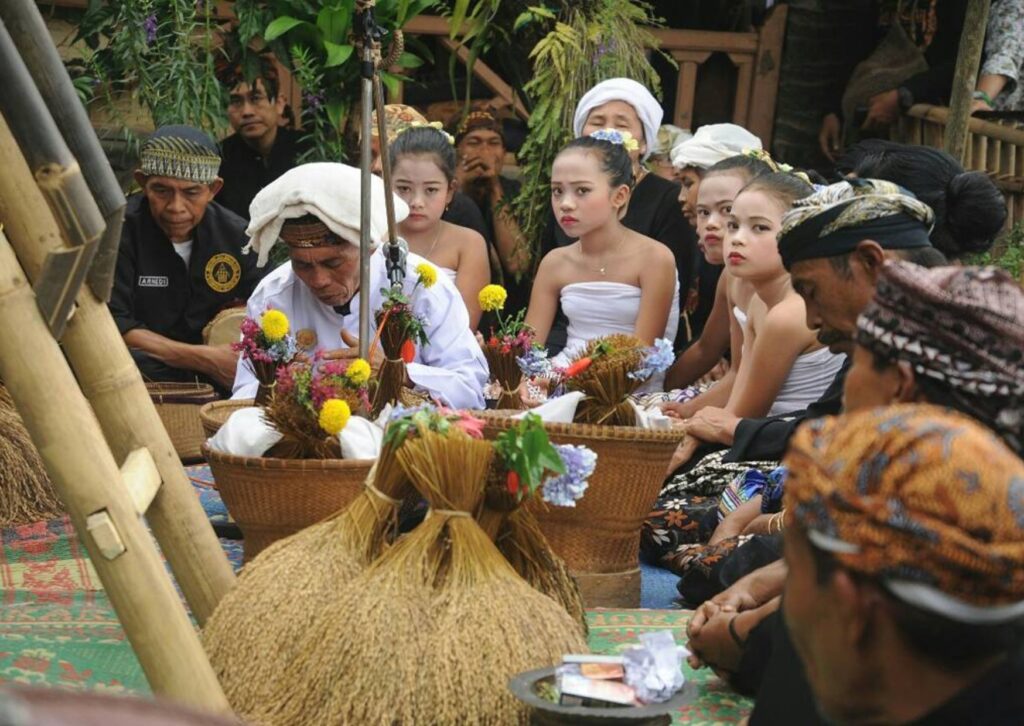
Before engaging more deeply with the concept of the Divine, followers of Sunda Wiwitan are encouraged, through the teaching known as Pikukuh Tilu, to develop an understanding of themselves and of the world around them. This foundational guidance stresses that spiritual awareness must begin with self-knowledge and responsible social conduct.
Pikukuh Tilu comprises two principal elements: cara ciri manusia (the characteristics of being human) and cara ciri berbangsa (the characteristics of belonging to a nation). Cara ciri manusia concerns standards of etiquette and moral virtue. Etiquette provides direction on how individuals ought to conduct themselves in accordance with Sundanese customs and social norms. Moral virtue, meanwhile, underscores that outward behaviour must be accompanied by righteous intention and action, since failure to uphold these values may lead to social disapproval or communal sanction.
By contrast, cara ciri berbangsa relates to the preservation of Sundanese identity. It is often articulated through the well-known philosophical triad silih asah, silih asih, and silih asuh, commonly understood as mutual learning, mutual love, and mutual care. These principles are expressed in daily life through compassion, refined manners, attentiveness to social hierarchy and ethics (undak-usuk), creativity and thoughtfulness in speech (budi daya–daya budi), and wisdom coupled with self-restraint in one’s conduct (wiwaha yuda na raga).
Taken together, Pikukuh Tilu reflects a broader endeavour to cultivate awareness of the Divine, of fellow human beings, and of the natural world. Human life is thus understood not merely as biological existence, but as the fulfilment of a sacred trust bestowed by the Supreme Being, often referred to as Sang Hyang Kersa.
The Theological Foundations and Core Teachings of Sunda Wiwitan
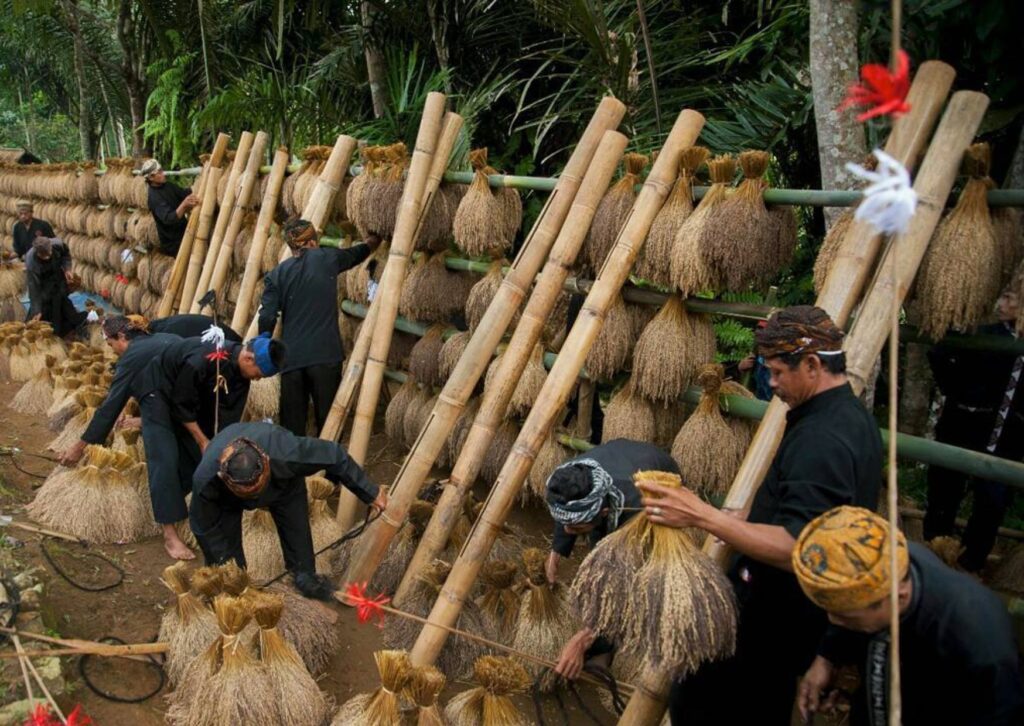
The theological outlook of Sunda Wiwitan is monotheistic. God is addressed through reverential titles such as Gusti Nu Maha Suci, Gusti Nu Sa Wiji-wiji, and Sang Hyang Kersa. Knowledge of the Divine begins through a spiritual stage known as Lengkah Munggaran, an inward journey marked by fundamental questions such as “Saha kuring?” (Who am I?) and “Keur naon kuring hirup?” (What is the purpose of my life?). These inquiries serve as gateways toward understanding one’s essence, life mission, and spiritual relationship with God. In this worldview, every human being is believed to be a messenger entrusted with particular responsibilities in the world. Should these responsibilities remain unfulfilled, the soul is thought to undergo rebirth or reincarnation in order to complete them.
Spiritual accountability in Sunda Wiwitan is not framed as the binary of heaven and hell that commonly found in Abrahamic traditions, but through the principle of karma, the belief that every action generates consequences that shape future existence, both for oneself and for one’s descendants. Ethical values are therefore causal and continuous, emphasizing that present conduct determines future harmony. This perspective is encapsulated in the principle “ulah lali ka asal, ulah mopoh ka jati diri”, a reminder not to forget one’s origins and true identity, highlighting reciprocal ties between humans, ancestors, and the natural world.
Sunda Wiwitan should not be understood solely as an ancestral inheritance, but as a living philosophy sustained through cultivated self-awareness. From birth, individuals are situated within the cultural framework of Sundanese tradition, including the values and cosmology associated with Sunda Wiwitan. Yet the deeper significance of its spiritual teachings does not arise automatically; it emerges through reflective engagement with one’s own existence. This idea is captured in the expression “bujeng-bujeng dimimitian aya kahayang”, which suggests that although one cannot determine the circumstances of one’s birth, one possesses the will and consciousness to seek an understanding of one’s place within the natural and cultural universe of Sunda
This sense of existential awareness gives rise to what is known as karumasaan, a deep inner sensitivity toward the meaning of life and the interconnected relationship between humans, nature, and the Creator. Within this perspective, spiritual practice in Sunda Wiwitan goes beyond the performance of rituals. Instead, it is understood as an inward and reflective process carried out with conscious awareness.
Interestingly, adherents often avoid direct mention of God’s name, opting instead for honorific expressions that reflect ajri, a disposition of reverence, humility, and sacred respect. This linguistic ethic illustrates that divinity in Sunda Wiwitan is not confined to doctrinal belief but is embodied in everyday moral conduct grounded in compassion and harmony. In this sense, Sunda Wiwitan articulates the principle of belief in the One Supreme God within Indonesia’s philosophical foundation in a contextual and grounded manner, where spirituality is lived through ethical responsibility, cosmic balance, and reverence for all existence.
Sunda Wiwitan in Modern Society
In the contemporary digital era, however, the transmission of these values faces increasingly complex challenges. The widespread use of smartphones and social media has gradually shifted younger generations’ attention away from local spiritual and cultural practices. Although the community has adapted by modifying educational approaches to make traditional teachings more accessible, the homogenizing influence of formal schooling and the dominance of external cultural currents continue to exert significant pressure on the preservation of indigenous values. In response, the philosophy of “kiwari nganceuk bihari”, adapting to the times, has been adopted as a pedagogical foundation, integrating spiritual education into children’s everyday worlds. This approach resonates with the proverb “mangsana anak mah mangsana ulin,” which underscores learning through play and lived experience so that ancestral values may be absorbed naturally and joyfully.
Socially, Sunda Wiwitan believers continue to encounter negative stigma, at times being labeled as followers of a “deviant” faith or even accused of impiety. Consequently, some community members feel compelled to list officially recognized religions on their national identity cards (KTP) to secure administrative access to public services. The ambiguous legal standing of indigenous belief systems has also generated practical complications in daily life, particularly in the conduct of funerary rites, which can provoke confusion or even rejection from surrounding communities. These realities underscore the urgency of formal recognition and legal protection for local belief systems such as Sunda Wiwitan as part of safeguarding citizens’ constitutional rights.
Despite these challenges, the Sunda Wiwitan community continues to reinforce its philosophical foundations through the preservation of customary law, intra-community marriage, and the lived practice of teachings such as Tunggul Sabibit, Tunggal Sabakal, Tunggal Makhluk Allah, which emphasize the unity of creation and serve as an ethical basis for tolerance. For the community, official state recognition is hoped for not only as a matter of legal status but as a tangible affirmation of religious freedom and of the national principle of unity in diversity.
Contributor: Aldiza Syifa Maura Pramudhita
Bibliography
Ashri, Abdullah Fikri. “Penghayat Kepercayaan: Sulitnya Kami Menikah secara ”Resmi.”” Penghayat Kepercayaan: Sulitnya Kami Menikah secara ”Resmi”, 31 March 2021.
Ashri, Abdullah Fikri. “Tidak Diakui, Ruang Hidup Masyarakat Sunda Wiwitan Terancam.” Tidak Diakui, Ruang Hidup Masyarakat Sunda Wiwitan Terancam [Jakarta], 2021.
Indrawardana, Ira. “Berketuhanan dalam Perspektif Kepercayaan Sunda Wiwitan.” Melintas, 2014, pp. 105-110.
Jubba, Hasse. “SUNDA WIWITAN DI ERA POST-TRUTH: STRATEGI BERTAHAN KOMUNITAS LOKAL DI ERA GLOBALISASI.” Jurnal Jurnal Studi Agama dan Masyarakat, vol. 17, no. 02, 2021, p. 150.
Pribadi, Irfan Teguh. “Mengenal Sunda Wiwitan dan Agama Sunda yang Lain.” 20 August 2017, https://tirto.id/mengenal-sunda-wiwitan-dan-agama-sunda-yang-lain-cvhD.
Qhoirunnisa, Salsabila, et al. “Sistem Kepercayaan Sunda Wiwitan Sebagai Wujud Nilai Ketuhanan Dalam Pancasila di Kampung Adat Cireundeu.” Indo-MathEdu Intellectuals Journal, vol. 6, no. 3, 2025, pp. 4224-4234.
Sihombing, R.A. “Problematika Hukum dan Administrasi Kependudukan bagi Penganut Kepercayaan di Indonesia.” Jurnal Hukum dan Pembangunan, vol. 52, no. 1, 2022, pp. 89-107.
Subarna, Ubay. “Ngancik Nu Bihari.” Sunda Urang, 28 March 2023, https://www.sundaurang.id/pedaran/9488242191/ngancik-nu-bihari.
Tepangsono by Yohanes Agus Juhari Umat Paroki St. Melania.
